
Frozen Egg Donation” is an alternative to “fresh” (non-frozen) Egg Donation IVF treatment. Just like “fresh” Egg Donation, it can be a highly successful treatment for patients who no longer have sufficient quality eggs within their ovaries.
You choose your frozen donor eggs from a donor egg bank catalog. This is similar to choosing donor semen from a sperm bank.
Once you select the egg donor of your frozen eggs, the egg bank will ship your selected frozen eggs to your fertility clinic. Some of the Egg Banks are: Fairfax Egg Bank, Donor Egg Bank USA at California Cryobank, and Cryos International-USA.
Probability of Success: The likelihood of a successful pregnancy depends primarily on the fertility potential of the egg donor who provided your frozen donor eggs rather than your uterine receptivity or age.
The probability of a successful outcome with frozen donor eggs approaches the success of using “fresh” donor eggs.
Treatment Efficacy: Donor Egg IVF has become a mainstream treatment for infertility.
Frozen Donor Egg IVF Offspring: Children conceived with the help of Donor Egg IVF are genetically linked to the male partner and the egg donor, but the female partner is the one who becomes pregnant, nourishes the baby throughout the pregnancy, and experiences childbirth.
The baby receives one set of genes from the dad and another from an egg donor, but you, the mom carrying the pregnancy, make that baby your very own. The new science of epigenetics describes how our environment modifies gene expressions and possibly the genes themselves.
The epigenetic marks transmitted from the recipient mother are a fine-tuned mechanism to control gene activation during the complex process of early embryogenesis. And this maternal influence continues throughout the pregnancy. You will imprint yourself onto the baby! By the time your son or daughter is born, that baby will be biologically yours.
“Fresh” and Frozen Egg Donor IVF Comparison: In “fresh” Donor Egg IVF, the egg donor undergoes ovarian stimulation and egg retrieval. The eggs are inseminated with partner (or donor) sperm, and fertilized eggs are cultured in the laboratory. The resulting embryos are cryopreserved and subsequently transferred into the recipient mother’s uterus.
In Frozen Donor Egg IVF, the egg donor’s ovarian stimulation and egg retrieval have already taken place. The eggs have been vitrified (cryopreserved, frozen) by the egg bank. The cryopreserved eggs are shipped to an IVF clinic, where they are thawed, inseminated, and the resulting embryos are frozen and subsequently transferred into the recipient mother’s uterus.
In both types of donor egg treatments, egg donors are tested for genetic and infectious diseases and are psychologically pre-screened.
Advantages of Frozen Donor Egg IVF: Frozen Donor Egg IVF may possibly be less costly than “fresh” Donor Egg IVF. The treatment length is shorter, and you may not need to decide what to do with extra embryos that might be left over after a successful “fresh” Donor Egg IVF treatment.
Advantages of “Fresh” Donor Egg IVF: “Fresh” Donor Egg IVF may have a higher success probability, and you may possibly have enough extra frozen embryos to improve your chances for a genetic sibling in the future.
Treatment Logistics: The rate of development of embryos from frozen donor eggs may be unpredictable, and it may not be possible to match the recipient’s uterine lining development with the development of the embryos.
This is resolved by thawing and inseminating the frozen donor eggs and freezing (vitrifying) the resulting embryos. The frozen embryos are thawed and transferred into the uterus in a subsequent Frozen Embryo Transfer.
Most embryos will survive the cryopreservation and thawing process. The implantation rate of the thawed embryos is equal to the “fresh” embryo implantation rate.
Obstetrical Care: Once your Frozen Embryo Transfer treatment is completed (approximately 6-8 weeks into your pregnancy), your pregnancy will become indistinguishable from conception through intercourse, and your obstetrical care should be no different than if you conceived without any treatment.
Frozen Donor Egg IVF is a two-stage treatment. The first phase consists of the development and cryopreservation of embryos:
- Obtaining donor eggs from an egg bank
- Thawing of cryopreserved donor eggs
- Fertilization of eggs (Intracytoplasmic Sperm Injection – ICSI)
- Culture of embryos
- Cryopreservation of embryos
- Embryo storage
The second stage consists of the Frozen Embryo Transfer cycle.
Obtaining Donor Eggs from an Egg Bank: Once you have finalized the selection of your donor eggs, the egg bank will communicate with your fertility clinic, and their Embryology Laboratory will make preparations to receive your eggs. After their cryopreservation in the egg bank, eggs are stored and transported in liquid nitrogen containers. Once your eggs arrive at an IVF clinic, they will be kept in liquid nitrogen storage until it is time to thaw them.
Thawing of Cryopreserved Donor Eggs: Since it is expected that not all cryopreserved eggs will survive the freezing-thawing process, and since not all thawed eggs will fertilize or develop into healthy embryos, you will be purchasing a cohort of eggs. You should expect to receive between 5 and 8 vitrified eggs from the egg bank.
Such a cohort will likely produce some good-quality embryos suitable for transfer.
Fertilization of Eggs: The male partner collects a semen specimen by masturbation on the day of thawing the eggs. The highest quality sperm are extracted from the semen, and Intracytoplasmic Sperm Injection (ICSI) is performed. In ICSI, a single sperm is inserted into an egg. ICSI is necessary for the fertilization of cryopreserved eggs.
Culture of Embryos: Evidence of fertilization can be seen the next day, 16 hours after ICSI. The fertilized eggs are transferred into a growth medium and continue to be cultured.
A normally fertilized egg (zygote) will show two pronuclei representing the genetic material from the egg and sperm.
The following day, embryos should divide into 4 cells, and the day after that, into 8 cells.
This picture shows a morphologically exquisite, day three, 8-cell embryo. Human embryos are still microscopic and invisible to the naked eye at this stage.

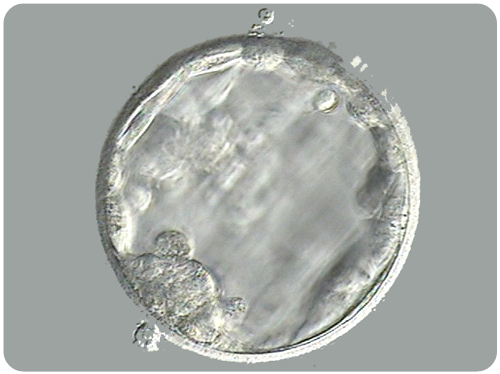
By the fifth to seventh day after the insemination, embryos should reach the blastocyst stage (80 or more cells).
This picture shows an advanced stage of blastocyst development. Notice the central fluid-filled cavity. The cells within the blastocyst have already differentiated into the inner cell mass (at seven o’clock) that will give rise to the fetus and the trophectoderm cells that will form the future placenta.
Cryopreservation of Embryos: Embryos that develop normally are cryopreserved. Preparation for the freezing process involves removing water from within the embryos and replacing it with a cryoprotective substance to prevent ice crystal formation during vitrification and subsequent thawing. The embryos are then flash-cooled to -196°C (-321°F). Such rapid freezing (vitrification) prevents damaging water crystal formation.
Embryo Storage: Following the vitrification process, the embryos are transferred into a liquid nitrogen storage chamber. Theoretically, there is no limit on the length of storage, but conceiving past the age of 40 may result in a high-risk pregnancy.
Once you decide to conceive with your cryopreserved embryos, you will have one or two embryos thawed and transferred into your uterus. A large majority of the embryos will survive the vitrification and thawing process. The implantation rate of the thawed embryos should be the same.